
Not all EV charging hours are equal
CleanCharge Live shows how Victoria’s grid emissions change across the day and identifies lower-carbon times to charge.

Oleksandr/Adobe Stock 1965406045
It is well known that the emissions associated with charging an electric vehicle depend on how the electricity is generated. What is less widely understood is how much the charging footprint of an EV drawing electricity from the grid can change from one hour to the next, whether it is plugged in at home or at a public charger. Households charging directly from their own rooftop solar are a different case.
Most drivers have no practical way of seeing this variation. Charging apps commonly show location, availability, charging power and price, but rarely indicate how the expected emissions associated with charging may change over the course of the day.
Evidence from a recently published study of Victoria’s electricity system and Melbourne’s public charging network shows how drivers can identify periods when charging is likely to produce lower emissions.
Those findings informed the development of CleanCharge Live, an open research platform that uses a rolling history of electricity-system observations to forecast a lower-carbon charging period each day.
Once actual observations become available, the archived forecast is evaluated against what occurred. This evaluation creates a transparent record of where the forecast and charging recommendation performed well or poorly. That evidence can then be used to refine the forecasting approach and improve how future recommendations communicate uncertainty and charging flexibility.
EV charging emissions can change substantially within a single day
Electricity may appear to be a uniform product when it reaches a household socket or public charger, but the mix of generation behind it changes throughout the day.
At one hour, electricity supply may include a larger contribution from solar and wind generation. A few hours later, solar output may have fallen, electricity demand may have changed, and more fossil-fuel generation may be needed. As this generation mix changes, so does the carbon intensity of electricity drawn from the grid.
The observed data shown below illustrate how pronounced this variation can be. Across the recent seven-day period, hourly carbon intensity ranged from approximately 405 to 1,079 gCO₂/kWh. Meaningful differences also occurred within individual days. On 1 August, for example, carbon intensity fell from 1,079 gCO₂/kWh at 3 am to approximately 492 gCO₂/kWh at noon, a decrease of about 54%.
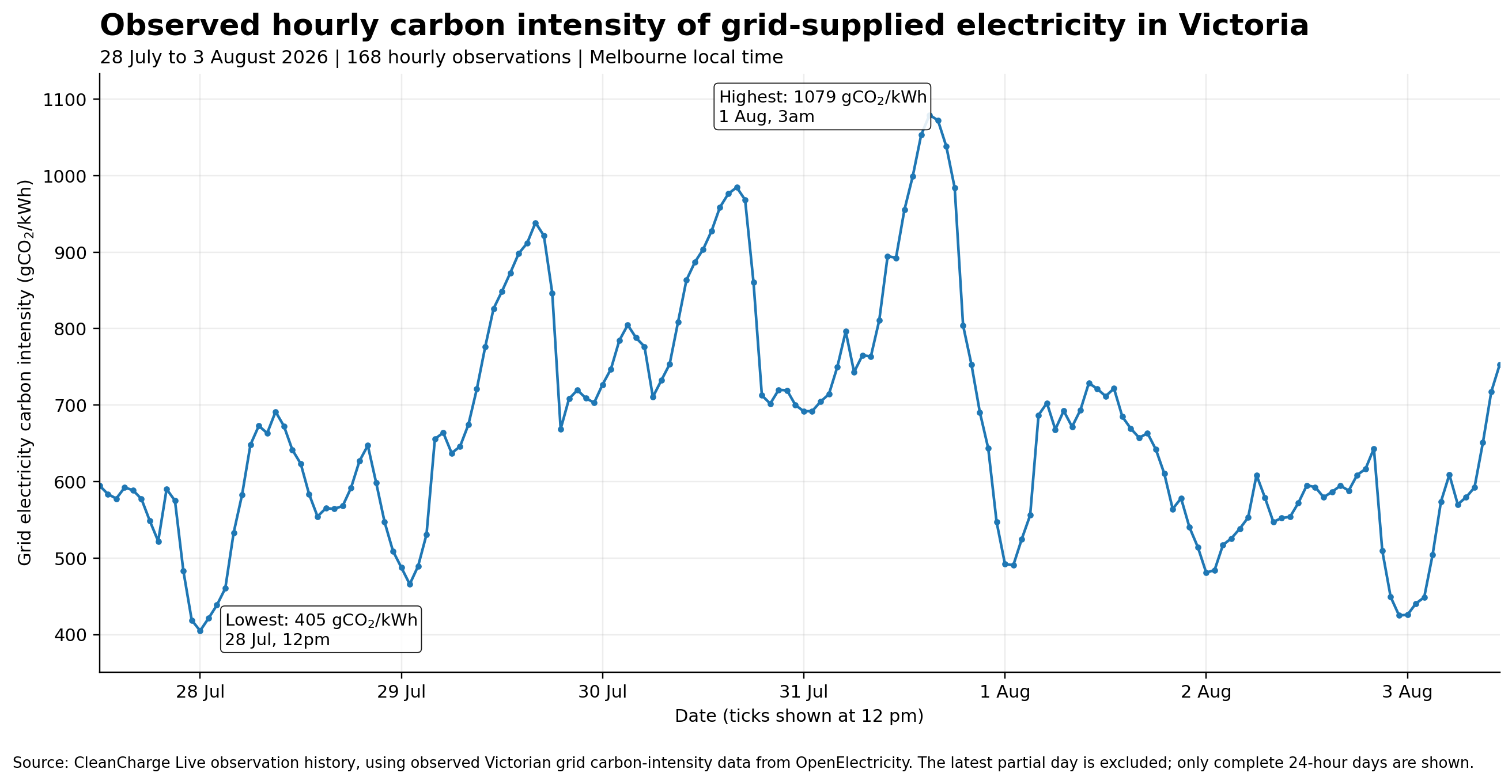
Hourly carbon intensity of Victoria’s grid electricity varied substantially across the week and within individual days.
For an EV drawing electricity from the grid, shifting a charging session from a higher-intensity period to a lower-intensity one can reduce its charging emissions without changing the amount of electricity used. The potential benefit becomes even more significant when considered across many vehicles and repeated charging sessions.
What the research found
The research found that lower-carbon charging periods in Victoria frequently occurred during the late morning and early afternoon, when solar generation was relatively strong. Higher-intensity periods were more common after solar output declined and the electricity system became more reliant on fossil-fuel generation.
However, there is no single “best” charging time that applies every day. Electricity demand, weather conditions, renewable generation, outages and other market conditions can all change the shape of the daily carbon-intensity profile.
Late morning may therefore often be favourable, but it should not be treated as a fixed rule. A more reliable approach is to use current electricity-system data to estimate the most promising charging period for each day.
The CleanCharge Live platform
CleanCharge Live was developed to translate the research findings into practical, publicly accessible charging guidance.
Each day, the platform retrieves recent electricity-system observations, updates its rolling data history and forecasts how grid carbon intensity is likely to change over the day. It then identifies one model-selected lower-carbon charging period for a representative 20 kWh charging session using a 7 kW charger, equivalent to approximately three hours of charging.
The public dashboard displays the recommended charging period, the forecast carbon intensity during that period, the estimated emissions from the charging session and the potential saving relative to highest-intensity charging period forecast for that day.
To demonstrate how the system works using a forecast selected before its outcome was known, the example below follows the recommendation published for Monday 3 August 2026. Using only the electricity-system information available at the time, CleanCharge Live recommended charging between 11:00 AM and 2:00 PM. For the representative 20 kWh session, this period was forecast to produce 28.7% fewer emissions than the highest-intensity charging period identified for that day.
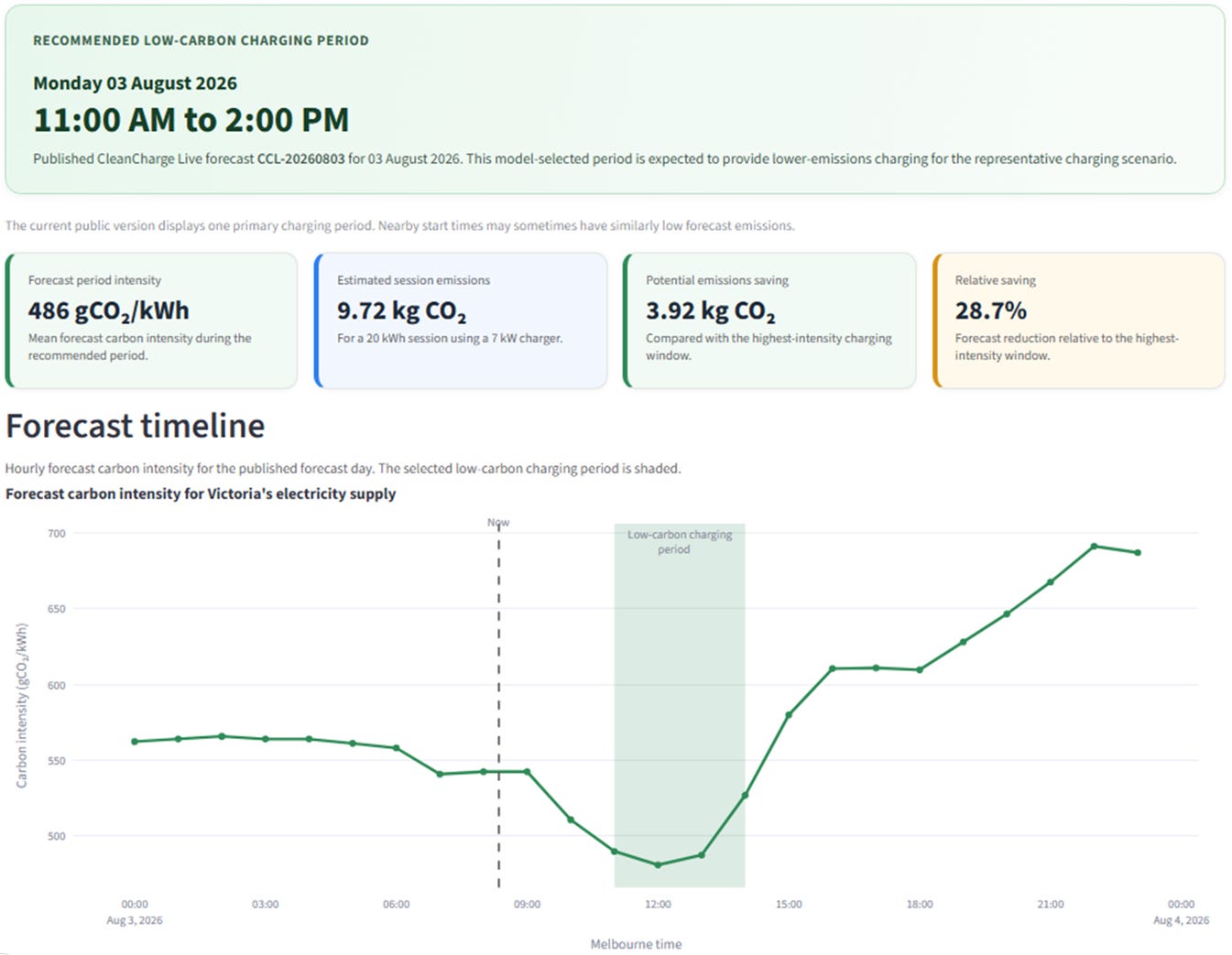
CleanCharge Live forecast published on the morning of 3 August 2026. The shaded area shows the model-selected lower-carbon charging period.
Once the actual electricity observations became available the following morning, on Tuesday 4 August, the archived recommendation was evaluated against what occurred. It achieved a Carbon Savings Capture of 100%, meaning that the published recommendation captured the full emissions reduction that would have been available with perfect hindsight.
The recommended period began at exactly the same time as the actual lowest-carbon charging period, producing a timing error of zero hours and 100% window overlap. Although the hourly forecast was not exact, with a mean absolute error of 45 gCO₂/kWh and a moderate fit to the observed hourly pattern, it correctly identified the most effective time to charge.
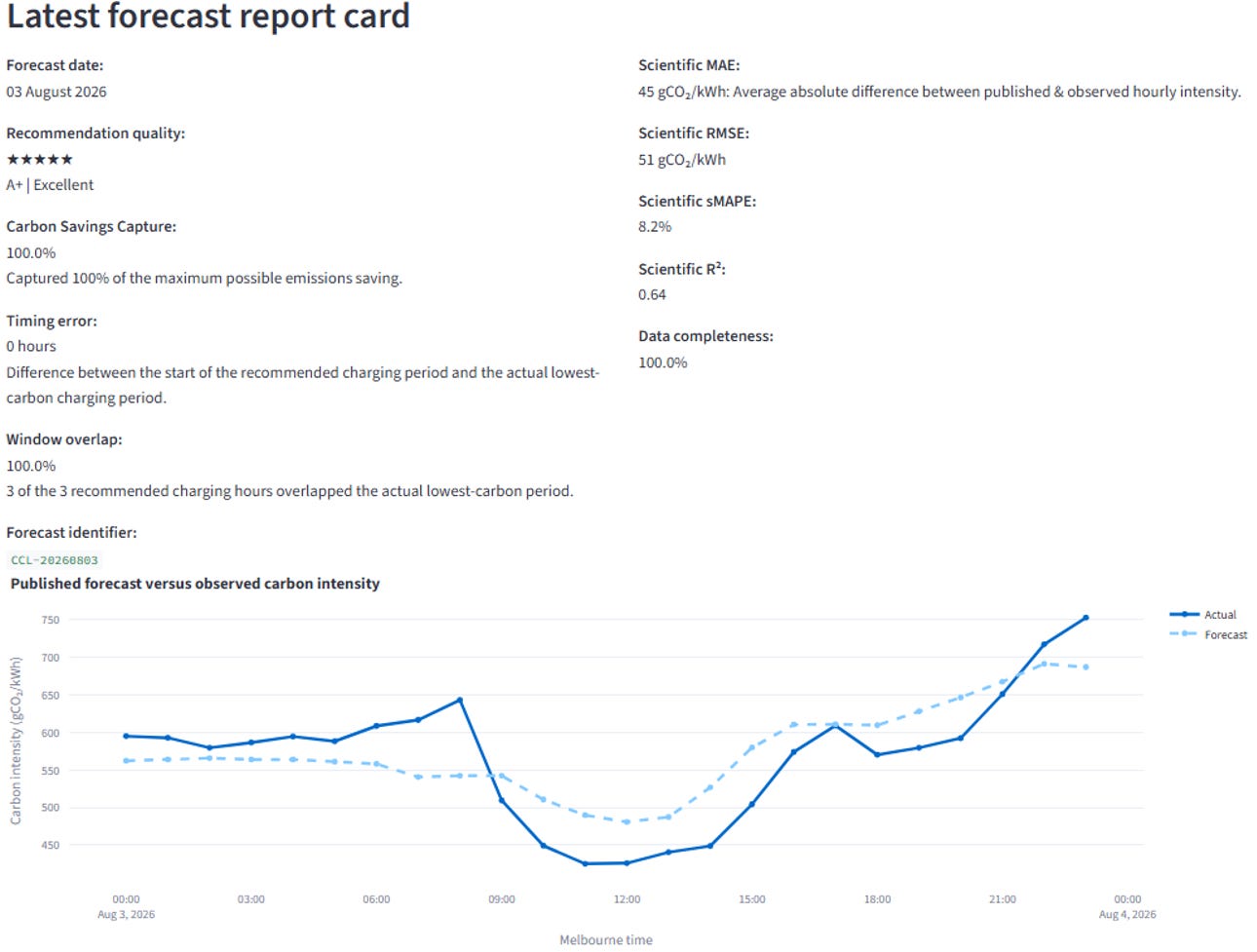
Evaluation of the 3 August recommendation after actual grid observations became available. The recommended period achieved 100% Carbon Savings Capture, zero timing error and complete overlap with observed lowest-carbon charging period.
This measure focuses on the practical value of the recommendation. It asks not whether every hourly forecast value was exact, but whether the forecast successfully identified a highly effective time to charge.
Drivers do not need to install software or work through the underlying data. They can open the public dashboard to view the current recommendation, then return later to see how the forecast performed against the observed grid conditions.
What CleanCharge Live can tell you
CleanCharge Live is a research and decision-support platform, not a personalised charging controller. Its recommendations reflect electricity-system conditions across Victoria, as represented by the Victorian region of the National Electricity Market.
The platform does not currently account for an individual household’s electricity tariff, rooftop solar generation, battery storage, local network constraints, vehicle requirements or preferred departure time.
These factors can materially affect the best charging decision for an individual driver. A household able to charge directly from abundant midday rooftop solar may reasonably make a different choice from someone using a public charger. A driver on a time-of-use tariff may also need to balance emissions considerations against electricity prices.
CleanCharge Live should therefore be interpreted as transparent, forecast-based guidance rather than guaranteed or personalised operational advice.
Research implications
The central message of this research is that transport electrification creates new opportunities to coordinate charging with a changing electricity system.
As renewable generation grows, the emissions associated with electricity use will increasingly depend on when that electricity is consumed. Future charging apps could display expected carbon intensity alongside charger availability, charging speed and price. Vehicles and charging systems could identify lower-emissions opportunities automatically, while fleet operators could incorporate electricity-system conditions into charging schedules without compromising operational requirements.
These benefits, however, will depend on whether drivers have meaningful flexibility and whether suitable charging infrastructure is available where and when it is needed.
The next generation of EV charging should therefore be not only larger, but also smarter, more transparent and more equitable.
Next research steps
The current public version presents one primary charging period for clarity. In practice, nearby starting times may sometimes produce similarly low forecast emissions.
Current development is testing how these near-equivalent periods could be communicated as flexible charging ranges without materially reducing emissions performance. This matters because people rarely organise their lives around an exact algorithmic optimum. A recommendation becomes more useful when it identifies several practical options that are expected to produce almost the same environmental benefit.
Later development will also explore different charging requirements, charger power levels and practical constraints, allowing the platform to represent a wider range of household, public-charging and fleet applications.
Explore the project and follow its progress
CleanCharge Live is an experiment in making an otherwise invisible part of the energy transition visible.
The peer-reviewed research provides the scientific foundation, while the underlying data and code are openly available. The live platform translates those findings into a daily forecast that anyone can examine, use and revisit after the actual electricity observations become available.
Each published recommendation becomes part of an ongoing record of how well the forecast performed and how much of the available emissions saving it captured. The forecast is live. The methods are open. And the system will continue to be tested against what actually happens each day.
Try CleanCharge Live: https://cleancharge-live.streamlit.app/
View CleanCharge Live repository: https://github.com/hdia/cleancharge-live
Read the peer-reviewed paper:
Dia, H. (2026). CleanCharge: Emissions-aware electric vehicle charging and infrastructure equity with open data in Melbourne. International Journal of Sustainable Transportation, 1–27. https://doi.org/10.1080/15568318.2026.2693676
Explore the research paper code and data: https://github.com/hdia/cleancharge